Free, practical guides written by our training team — from manual handling and lifting technique to fire safety, first aid and food hygiene. Learn the essentials, then get certified in minutes.
Our online safety courses are benchmarked to the requirements of:
Manual handling is one of the most regulated everyday activities in any Irish workplace, yet the law behind it is often misunderstood. This…
Read article →
Lifting, carrying, pushing and pulling are part of almost every Irish workplace — and they are also behind a large share of the injuries reported…
Read article →
One of the most common questions we hear from Irish employers and workers is simple: how much am I legally allowed to lift? The answer surprises…
Read article →
Carers and healthcare staff move and assist people every day, and people are the most unpredictable load of all. Done well, it protects backs and…
Read article →
Warehouses and distribution centres run on movement. Pallets are loaded, orders are picked, cases are stacked and vans are filled, shift after…
Read article →
Most back injuries at work do not come from one freak accident — they come from lifting the wrong way, day after day. Good technique is simple to…
Read article →
Lifting, carrying, pushing and pulling are part of countless Irish jobs, and they cause a large share of workplace injuries every year. The good…
Read article →
TILE is the four-letter shorthand that turns a vague "is this safe to lift?" into four sensible questions. Here is what each letter stands for,…
Read article →
Skipping manual handling training can look like a saving until the day it isn't. Between Health and Safety Authority notices, court fines and the…
Read article →
Ladders are the most common access tool on Irish worksites — and one of the most misused. Used for the right job, checked properly and handled…
Read article →
The single most useful idea in work-at-height safety is the hierarchy of control: a ranked order of measures from most to least effective. Apply…
Read article →
If your business asks anyone to climb a ladder, mount a scaffold or work near an edge, you are bound by Irish work-at-height law. Here is what the…
Read article →
Falls from height remain one of the leading causes of serious workplace injury in Ireland. This guide explains what counts as work at height, what…
Read article →
A burst wheel travelling at full speed, a grinder that kicks back into the operator, a lungful of silica dust — abrasive wheel injuries are…
Read article →
Angle grinders, bench grinders and cut-off saws are everywhere on Irish sites — and the wheels they carry can shatter at thousands of revolutions…
Read article →
There is no dedicated abrasive wheels regulation in Ireland today — but that does not mean there are no rules. The duties sit firmly within…
Read article →
Changing a wheel looks like a thirty-second job, but it is the moment when most abrasive wheel disasters are set in motion. Done in the right…
Read article →
Asbestos is still buried in thousands of Irish buildings, and the people most at risk are the tradespeople who disturb it without realising.…
Read article →
Asbestos was once prized as a wonder material. Today it is one of the most serious occupational health hazards in Ireland — and the harm it causes…
Read article →
Ireland has a clear legal framework controlling work that could expose people to asbestos. Understanding the Exposure Regulations is the…
Read article →
Fire safety in Ireland is not just good practice — it is the law. Understanding who is responsible, what the duties are, and the consequences of…
Read article →
A fire can take hold in minutes and put lives, livelihoods and a whole business at risk. Good fire safety is not luck — it is a set of…
Read article →
A fire extinguisher is only useful if you can use it correctly under pressure. The PASS method gives you a simple, memorable way to act — and…
Read article →
Not all fires are the same — and using the wrong extinguisher can turn a small fire into a serious one. Knowing the classes of fire and the right…
Read article →
Behind every smooth, safe evacuation is a trained fire warden who knew exactly what to do. The role is one of the most practical and valuable in…
Read article →
When someone collapses in cardiac arrest, the minutes before the ambulance arrives decide everything. CPR and an AED, used quickly, can keep a…
Read article →
Every Irish employer has a legal duty to make sure first aid is available the moment someone is injured or falls ill at work. Here is what the law…
Read article →
It is the question every employer eventually asks: how many trained first aiders do we actually need? In Ireland the honest answer is that it…
Read article →
Physical injuries are visible; struggles with mental health often are not. Mental health first aid gives workplaces the awareness and confidence…
Read article →
The right PPE protects; the wrong PPE gives false confidence. This head-to-toe guide explains how to choose protective equipment that fits, works…
Read article →
Personal protective equipment is the most visible part of workplace safety, yet the rules around it are often misunderstood. Here is what Irish…
Read article →
Many people who die in confined spaces are the ones who went in to help. This guide explains why rescue planning must come before entry, and how…
Read article →
When entry into a confined space cannot be avoided, a permit-to-work is what keeps it safe. Here is how permits, testing and a safe system of work…
Read article →
From silos to basements, far more workplaces qualify as confined spaces than most people realise. Here is what Irish law means by the term, the…
Read article →
The risk assessment is the foundation of workplace safety in Ireland, and it is far simpler than its reputation suggests. Here is the legal duty,…
Read article →
A manual handling risk assessment is how you turn a legal duty into a practical decision about whether a lifting task is safe. This step-by-step…
Read article →
Breaking risk assessment into five clear steps turns a daunting legal duty into a routine anyone can follow. Here is the method, from spotting…
Read article →
The Safety Statement is a legal must for almost every Irish employer, yet it is widely misunderstood. Here is what it is, what it must contain,…
Read article →
For someone with a serious food allergy, the wrong meal can be life-threatening. Irish law is clear about what food businesses must tell their…
Read article →
Temperature is the single most powerful tool a kitchen has against harmful bacteria. Get the numbers right and you stop most food poisoning before…
Read article →
If you handle, prepare or sell food in Ireland, the law places real duties on you. Knowing who enforces those rules — and what they expect — is…
Read article →
Every food business in Ireland is legally required to operate a food safety management system based on HACCP. It sounds technical, but the idea…
Read article →
Paperwork alone does not keep people safe — culture does. Here is how Irish businesses build a safety culture that survives deadline pressure and…
Read article →
For a growing Irish business, safety training is as much an admin challenge as a learning one. Here is how to choose a platform that lets you…
Read article →Self-paced, HSA-aligned, available in 20 languages. Pass the short assessment and download your certificate the same day — valid for 3 years.
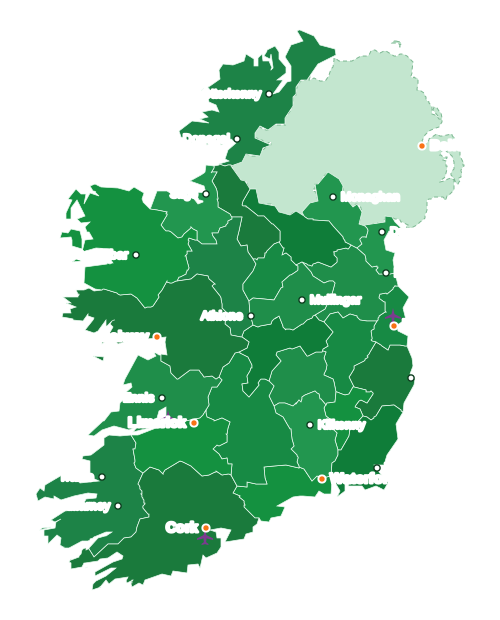
Take your course online from Dublin, Cork, Galway, Limerick, Waterford, Sligo - or any town in Ireland. Learn at your own pace on any device, and finish with an instant HSA-aligned certificate that's accepted in every county, nationwide.
We use strictly necessary cookies to make this website work. With your consent we also use analytics cookies to understand how the site is used and improve it. You can accept all, reject non-essential cookies, or set your own preferences. Read our Cookie Policy.