Manual Handling in Warehousing and Logistics
Warehouses and distribution centres run on movement. Pallets are loaded, orders are picked, cases are stacked and vans are filled, shift after shift. That relentless pace is exactly what makes manual handling such a defining safety challenge in Irish logistics.
The handling load behind every order
Few sectors involve as much physical handling as warehousing and logistics. From goods-in to dispatch, the same loads are lifted, lowered, carried, pushed and pulled many times over before they ever leave the building. With e-commerce driving ever shorter delivery windows, the volume and speed of handling have only increased. Behind the smooth arrival of a parcel sits a great deal of human effort, and a real risk of injury if that effort is not managed well.
In Ireland these tasks are governed by the Safety, Health and Welfare at Work Act 2005 and the General Application Regulations 2007 (Chapter 4 of Part 2)which require employers to avoid hazardous handling where reasonably practicable and to assess and reduce the risk where it cannot be avoided. In a busy warehouse, meeting that duty is about designing the work so that targets and safety pull in the same direction rather than against each other.
Repetitive lifting: the hidden hazard
The most dangerous thing about warehouse handling is rarely a single heavy item. It is repetition. A picker may handle hundreds of items in a shift, each one a small movement, but the cumulative strain on the back, shoulders and wrists adds up relentlessly. Add awkward postures — reaching into deep shelving, bending to floor-level stock, twisting to place items on a trolley — and the wear accelerates.
In a warehouse, the lift that hurts you is usually the thousandth one, not the heaviest one. Repetition is the load that hides in plain sight.
Pallets and stacking
Pallet work concentrates risk. Building a pallet means repeatedly lifting cases from a conveyor or floor and placing them at every height from ankle to above the shoulder. Breaking one down reverses the strain. The bottom layers force deep stooping; the top layers force overhead reaching, both of which place heavy demand on the spine and shoulders. Good pallet practice keeps the heaviest cases between knee and shoulder height, keeps the load close to the body, and avoids the temptation to over-stack to save a trip.
Manual Handling training from €35
Self-paced, HSA-aligned, certificate the same day — €35 per person.
Let the equipment take the strain
The single most effective control in logistics is to reduce how much a person lifts in the first place. A well-equipped warehouse gives workers the tools to move loads mechanically wherever possible:
- Pump trucks and pallet jacks for moving palletised loads instead of carrying cases by hand.
- Trolleys, cages and roll containers to carry multiple items in one trip rather than repeated armfuls.
- Conveyors, lift tables and scissor lifts to bring work up to a comfortable height and cut out bending.
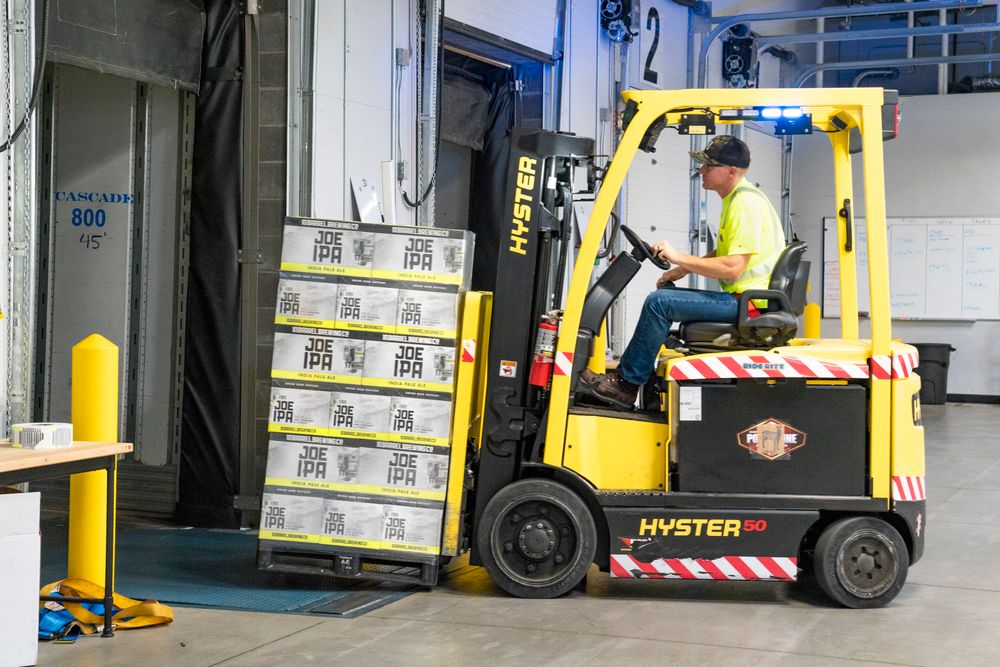
- Forklifts and reach trucks for high-level and heavy palletised storage, operated only by trained, authorised staff.
- Vacuum lifters and hoists for heavy, bulky or repetitive items where they fit the operation.
Just as important is layout. Storing the heaviest and fastest-moving stock at waist height ("the golden zone") removes a huge amount of bending and reaching. Keeping aisles clear, floors even and lighting good prevents the slips and awkward recoveries that cause sudden injuries.
Fatigue, pace and the end of the shift
Fatigue is a serious and often underestimated factor in logistics. Tired muscles protect the spine less well, concentration drops, and shortcuts creep in. The risk of a handling injury climbs towards the end of a long or fast shift, especially when targets push people to skip the trolley or grab one more case rather than make another trip. Managing fatigue is therefore a safety control in its own right: realistic targets, job rotation to vary the muscle groups used, adequate breaks, and a culture where it is acceptable to slow down rather than risk an injury.
Training ties all of this together. A certified manual handling course teaches warehouse staff to assess each load, use the right aid, position their body to protect the back, and recognise when fatigue or a tricky load means they should reset, ask for help or use equipment instead of muscle.
Key takeaways
- Repetition, not just weight, is the main handling hazard in logistics.
- The 2005 Act and 2007 Regulations require employers to assess and reduce the risk.
- Pallet building and breaking down concentrate strain at low and high levels.
- Pump trucks, trolleys, conveyors and lift tables should take the load off people.
- Storing fast, heavy stock at waist height cuts out bending and reaching.
- Fatigue raises injury risk late in the shift — manage pace, breaks and rotation.
- Trained workers lift smarter and use aids instead of muscle.
A high-performing warehouse and a safe one are not opposites. With the right equipment, sensible layout, fatigue management and well-trained staff, logistics operations can hit their targets while keeping the people who make them possible fit for the long haul.