CPR and AED Basics Every Workplace Should Know
When someone collapses in cardiac arrest, the minutes before the ambulance arrives decide everything. CPR and an AED, used quickly, can keep a person alive — and they are skills any workplace can build.
Cardiac arrest does not announce itself. A colleague can be working normally one moment and unresponsive the next. In that situation, ordinary people doing two simple things — starting chest compressions and using a defibrillator — make the difference between life and death. This guide explains the basics every Irish workplace should understand.
It is general information, not a substitute for hands-on training. The confidence to act under pressure comes from practising the skills properly.
Recognising cardiac arrest
A person in cardiac arrest is unresponsive and not breathing normally. They may make occasional gasping sounds — this is not normal breathing and you should treat it as cardiac arrest. Check quickly: shout, gently shake the shoulders, and look for normal breathing for no more than ten seconds.
If someone is unresponsive and not breathing normally, do not wait. Call for help, start CPR, and send for the nearest defibrillator.
The chain of survival
Survival depends on a series of actions happening fast and in order:
- Call 112 or 999 immediately and ask for an ambulance. Put the phone on speaker so the call-taker can guide you.
- Start CPR straight away with chest compressions.
- Use an AED as soon as one arrives.
- Hand over to the ambulance crew when they reach you.
How to give chest compressions
Kneel beside the person on a firm surface and:
- Place the heel of one hand in the centre of the chest, the other hand on top, fingers interlocked.
- Keep your arms straight and shoulders over your hands.
- Push down hard and fast — about 5 to 6 cm deep, at a rate of 100 to 120 compressions per minute.
- Let the chest rise fully between each push.
- If trained and willing, give rescue breaths in cycles of 30 compressions to 2 breaths. If not, continuous compressions alone are far better than nothing.
It is hard work. If others are present, swap every couple of minutes so compressions stay strong.
Using an AED
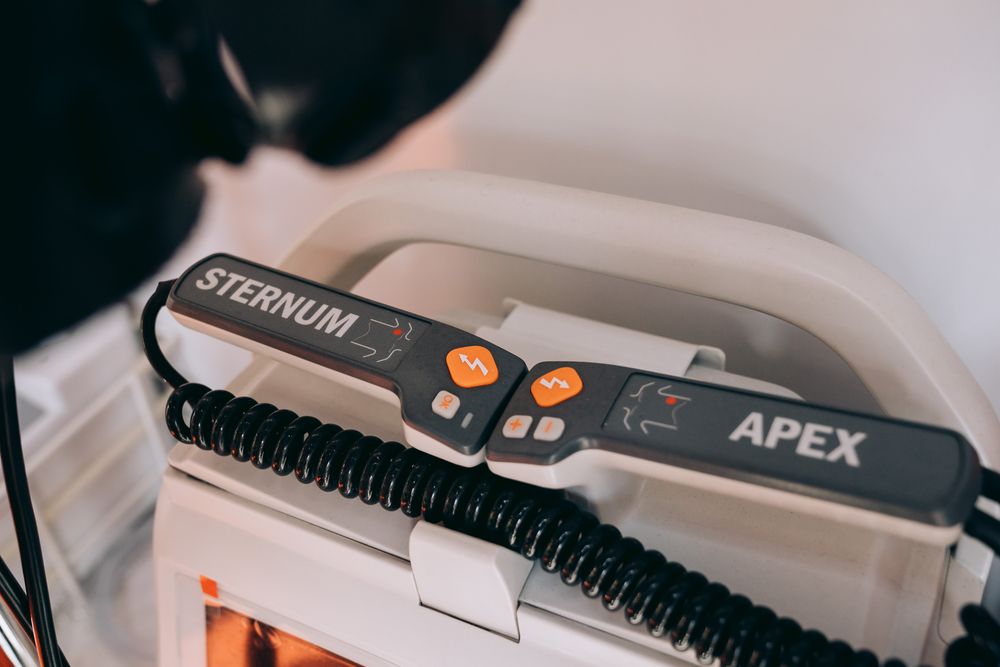
An Automated External Defibrillator (AED) is designed for untrained bystanders. Once switched on, it talks you through every step and will only deliver a shock if the heart rhythm needs one — it cannot shock a heart that should not be shocked. To use it:
- Turn it on and follow the spoken prompts.
- Expose the chest and attach the pads exactly as shown on the diagrams.
- Make sure nobody is touching the person while it analyses.
- If advised to shock, ensure everyone is clear, then press the button.
- Resume CPR immediately and keep following the prompts until help arrives.
First Aid training from €35
Self-paced, HSA-aligned, certificate the same day — €35 per person.
Making your workplace ready
Being prepared is part of meeting your first aid duties under the Safety, Health and Welfare at Work (General Application) Regulations 2007. Practical steps include:
- Knowing whether an AED is available on or near your premises, and where it is kept.
- Keeping any on-site AED accessible, signed and regularly checked (pads and battery in date).
- Training enough staff so several people are confident to act — see our guide on how many first aiders you need.
- Making sure everyone knows how to call the emergency services and direct them to your door.
These steps sit alongside your broader obligations, which we cover in first aid at work in Ireland.
Common worries — and why they should not stop you
Many people hesitate in an emergency not because they do not care, but because they are afraid of doing the wrong thing. It is worth addressing those worries directly, because hesitation costs precious time.
- "What if I hurt them?" A person in cardiac arrest is, in effect, clinically dead. CPR can only help. Cracked ribs are a known and acceptable risk when the alternative is no chance at all.
- "What if I use the AED wrongly?" The device will not deliver a shock unless the heart rhythm needs one. It guides you step by step and is built for people with no training.
- "I'm not confident enough." Confidence comes from doing. Even imperfect compressions vastly outperform standing by and waiting.
The only truly wrong action in a cardiac arrest is to do nothing. Every other choice gives the person a better chance.
After the emergency
Once the ambulance crew takes over, the immediate job is done — but a few things still matter. Note what happened and what was done, in case the medical team or your own records need it. Check on whoever performed CPR; it is physically and emotionally demanding, and people often need a moment afterwards. And review the incident calmly later, not to assign blame, but to learn whether your equipment, signage and training all worked as they should.
Key takeaways
- Cardiac arrest = unresponsive and not breathing normally — act at once.
- Call 112 or 999, start CPR, and use an AED as soon as it arrives.
- Push hard and fast in the centre of the chest, 100–120 per minute.
- An AED guides you and only shocks when needed — anyone can use it.
- Train several staff and know where your nearest defibrillator is.
You do not need to be a medic to save a life. You need to recognise the emergency, call for help, push on the chest, and let the AED do its job. The sooner those actions begin, the better the chance the person walks out of hospital.