Preventing Falls From Height: The Hierarchy of Control
The single most useful idea in work-at-height safety is the hierarchy of control: a ranked order of measures from most to least effective. Apply it properly and you stop falls at the source instead of relying on equipment to catch them.
Why a hierarchy at all?
Not all safety measures are equal. A guard rail that physically stops anyone from reaching an edge is far more reliable than a harness that depends on a worker clipping on every time. The hierarchy of control captures this: it ranks measures so that the most dependable, lowest-effort-for-the-worker options come first. Under Part 4 of the General Application Regulations 2007, Irish employers are expected to work down this order, only moving to a lower step when the higher one is not reasonably practicable.
Step one: avoid the work entirely
The safest height task is the one that never happens. Before committing anyone to working above the ground, ask whether the job can be done from the ground or designed out altogether. Long-reach tools let you clean, inspect or paint without climbing. Equipment can be assembled at ground level and lifted into place. Sensors and cameras can replace physical inspections. If the work can be avoided, no fall is possible.
Step two: prevent the fall
Where work at height is unavoidable, the next priority is to stop a fall from happening. This is where collective protection comes first — measures that protect everyone in the area without anyone having to do anything.
- Guard rails and barriers around edges, openings and platforms.
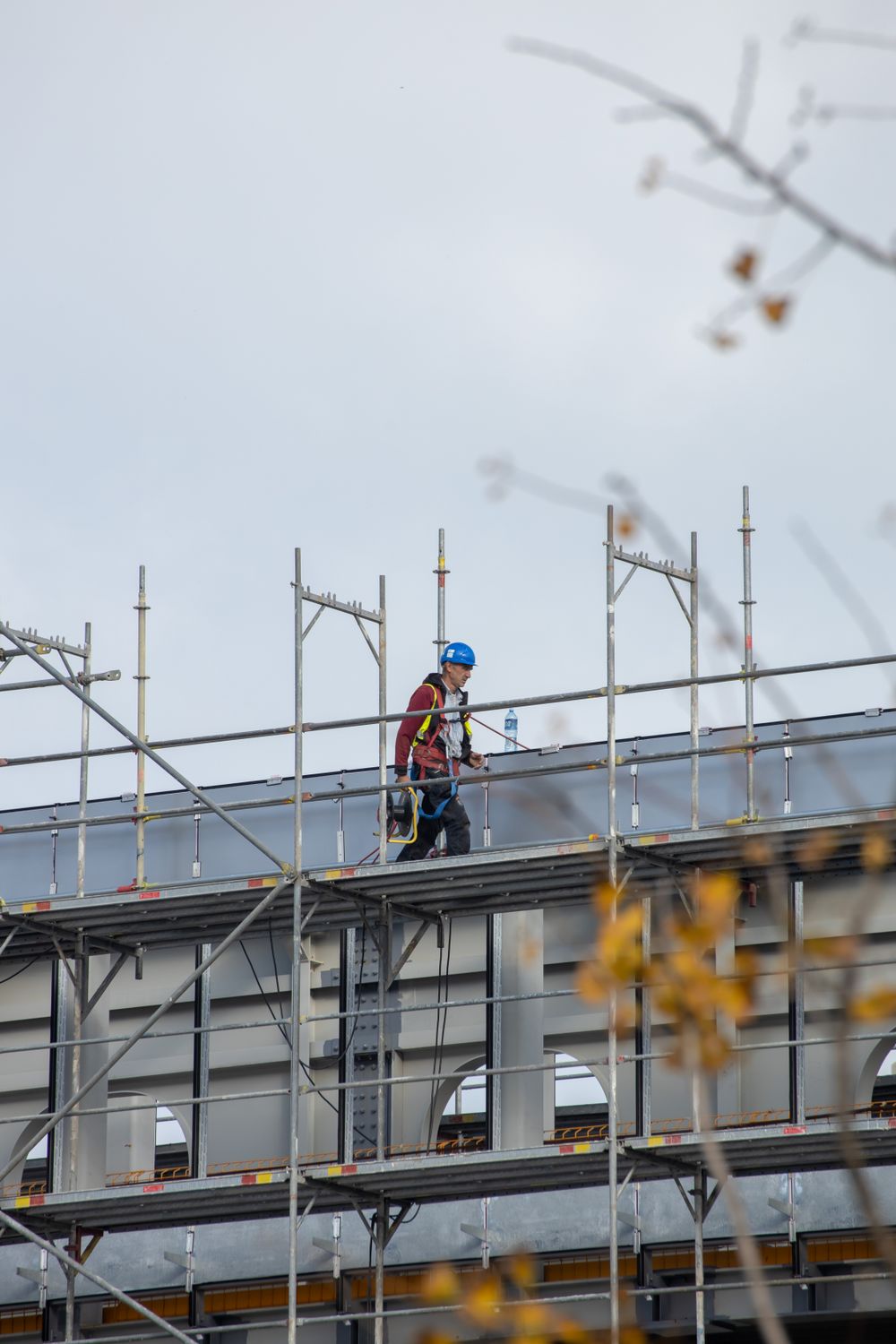
- Working platforms such as scaffolds, towers and powered access, fitted with edge protection.
- Covers over holes and fragile surfaces, secured and clearly marked.
Only when collective prevention is not reasonably practicable should you move to personal fall-prevention measures, such as a work-restraint system that physically prevents a worker from reaching a fall edge.
Collective measures protect everyone automatically; personal measures protect one person and only if used correctly every single time. That is why the law puts collective protection first.
Step three: reduce the consequences
If a fall cannot be prevented, the final tier aims to limit the harm. Again, collective options rank above personal ones. Safety nets and soft-landing systems catch a falling person and spread the load. Personal fall-arrest harnesses come last, because they only work if correctly fitted, anchored to a suitable point, and backed by a rescue plan for the suspended worker.
⭐ Key takeaways
- Work the hierarchy in order: avoid the work, prevent the fall, then reduce the consequences.
- Collective protection (guard rails, nets) always ranks above personal protection (harnesses).
- Harnesses are a last resort and useless without a rescue plan.
- Part 4 of the 2007 Regulations expects you to justify moving to any lower step.
Applying it on a real site
The hierarchy is not an abstract diagram — it is a question you ask of every task. Suppose a worker needs to clear a blocked gutter. Can it be reached from the ground with an extending tool (avoid)? If not, can a tower with edge protection be used (prevent, collective)? If the structure rules that out, is a restraint system feasible (prevent, personal)? Only after exhausting those should anyone reach for an arrest harness and net combination. Documenting that thought process in your risk assessment is exactly what an inspector wants to see. For the wider duties, read our guide to work at height law in Ireland.
Working at Heights training from €35
Self-paced, HSA-aligned, certificate the same day — €35 per person.
Why "reasonably practicable" is not a loophole
The phrase "so far as is reasonably practicable" runs through Irish safety law, and it is sometimes misread as permission to take the cheaper option. It is not. It requires you to weigh the risk against the time, trouble and cost of controlling it — and a serious risk of a fatal fall sits very high on that scale. In practice, the bar for justifying a lower step in the hierarchy is high, and cost alone rarely clears it. If a tower would prevent the fall and a ladder would only invite one, the tower is what reasonable practicability points to.
Common mistakes when applying the hierarchy
The most frequent error is jumping straight to harnesses because they feel like "doing something about safety," while skipping the more effective collective options above them. Another is treating the hierarchy as a one-time decision rather than a question for every task, every day. Conditions change: a method that was safe in dry weather may not be in high wind, and a control that suited one part of a job may be wrong for the next. Re-running the hierarchy as circumstances shift is part of using it properly.
- Reaching for personal protection before exhausting collective protection.
- Issuing a harness with no suitable anchor or rescue plan.
- Failing to reassess when the weather, surface or task changes.
- Recording a control on paper that no one actually uses on site.
The role of training
The hierarchy only works if the people on site understand it. A worker who does not know why a tower beats a ladder, or why a harness needs an anchor and a rescue plan, will default to whatever is quickest. Training builds that shared understanding so the safest option is also the obvious one. To see the hierarchy applied to the most common access tool, read our piece on ladder safety at work.